Activity manager
Activities what?
PeakTMS allows to model diverse activities within your organization. Each of them have might have different relevant information to be managed and need different resources to take place. Below an example of typical activities in PeakTMS:
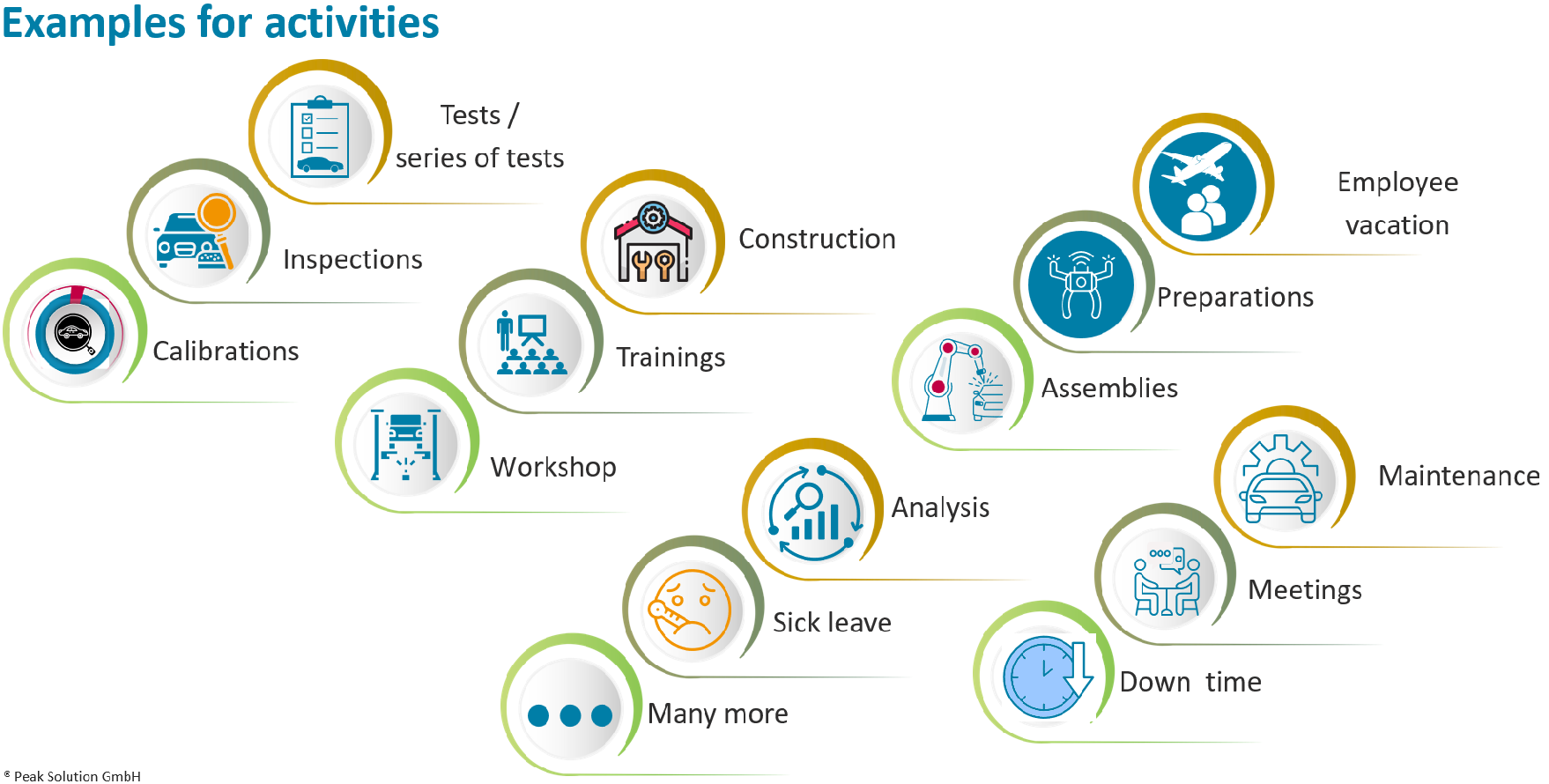
Typical PeakTMS activities
The available activities for your organisation and for you as user are defined and granted by your local administrator.
The activity manager
The activity manager allows you to create, maintain and search your diverse activities. The available activity types you will find in the tite menu below the entry 'activity':
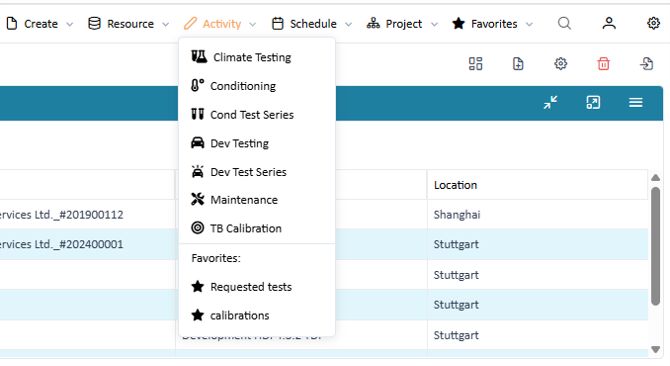
Starting the activity manager
If you miss some activity types than it might be that your administrator did not grant the necessary rights.
Below the activity types you find saved activityfavorites, list of resources with user specific filters and table columns.
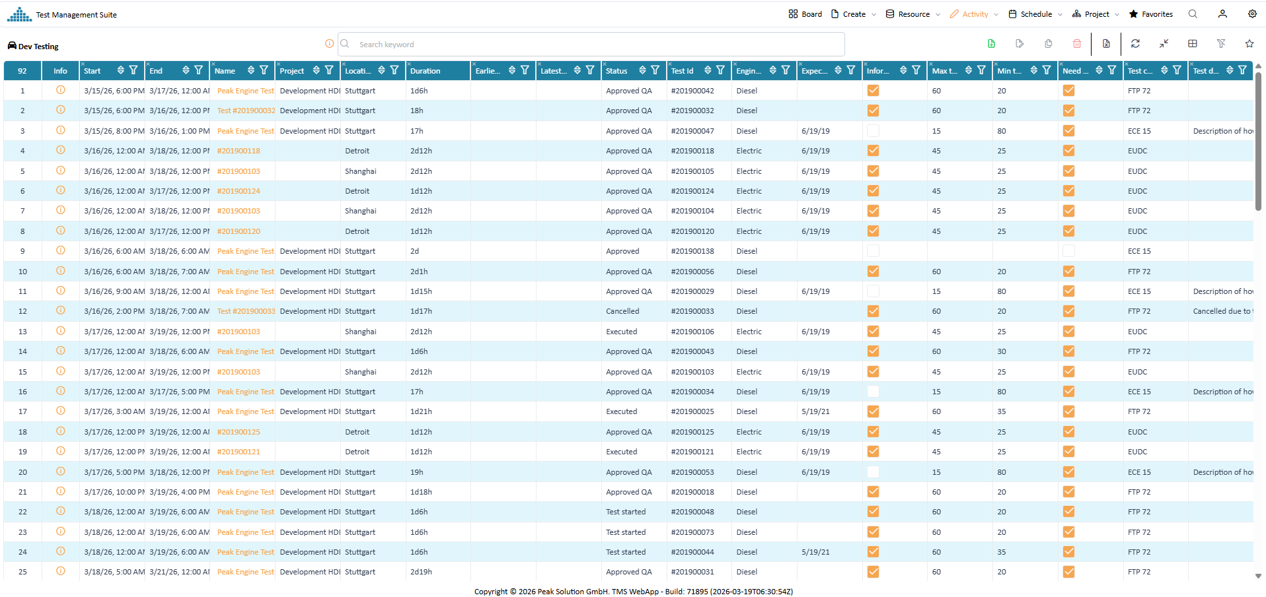
List of activities
Customize list view (General)
To fit list views to your needs to application provides you with powerful ways to customize your view.
List view customization
Filtering
To filter the shown data you can set a list of different filters.
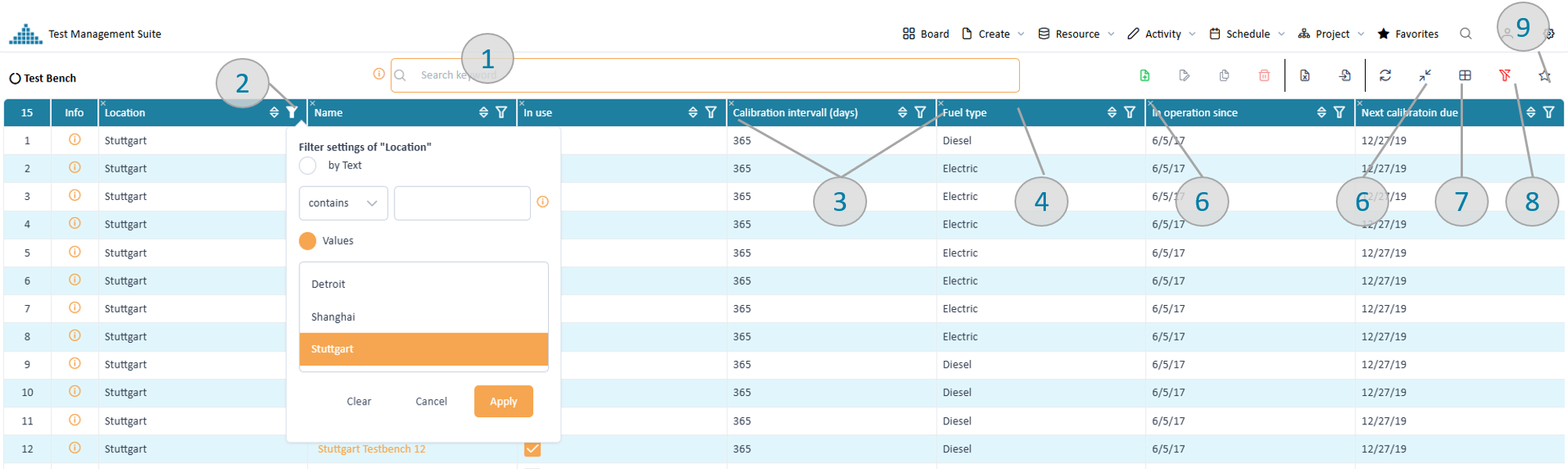
Key word filter (pic 1)
Entering one or several keyword expressions will search the entire data structure of each resource and add it to the filtered data. If you use several keywords, then they are "AND" connected. E.g. "Stuttgart electric" will only return data which contains Stuttgart and electric. Thereby both words can appear in different places of the resource.
Column filter (pic 2)
On top of the most columns the filter symbol provides filter options. Depending on the content type (e.g. text, number, date) different filter options will be provided. All column filter are "AND" connected therefore reducing the amount of shown data. Column filters can also be used together with the key word filter. In activities additional tabs allow to distinguish between columns of an activity itself and columns of the assigned resources. Therefore, you can filter on both. The tab role relates to the role of the resource in the activity, e.g. a test could have a passenger seat and a driver seat. In this case it allows to specifically search for attributes of "driver seat".
All filters can be cleaned using the clean-filter button (pic 8)
Adjust table columns
All columns can be adjusted in width by moving the separator between the column headers (pic 3). The order of the columns can be changed by you via dragging the column header to the desired position (pic 4). The button resize-table (pic 5) allows you to get your table back to screen size. A small 'x' at the left upper corner of each table header (pic 6).
With the column selector (pic 7) you can select additional columns to your table configuration.
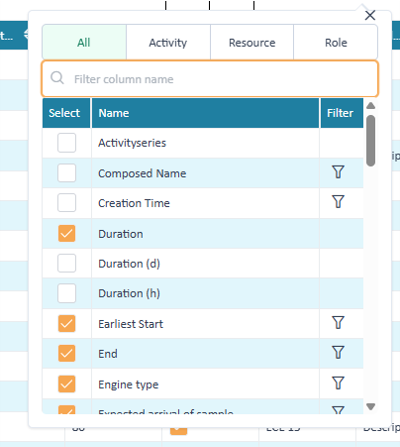
Column selector
Within the column chooser you can also set column filters. This becomes particular interesting if you want to filter data by a column but not want to see the column in the table.
Store your settings
The list view settings can be stored as favorite (pic 8). After saving the name of the list view will change according to your favorite name.
The stored favorites can be reused as data source for widgets in the dashboard.
Inspect your activity details in the detail page
To get more information about a data row you have 3 options
- click on the info icon in the "info" column provides a summary of the data
- clicking the link will navigate to the selected data row in a detail page
- double click the row will open a dialog to display the selected data with the detail page
PeakTMS uses a generic page to provide you with the specific data. Depending on activity types the page might be simple with just a few basic information or complex with descriptions containing more than 100 attributes.
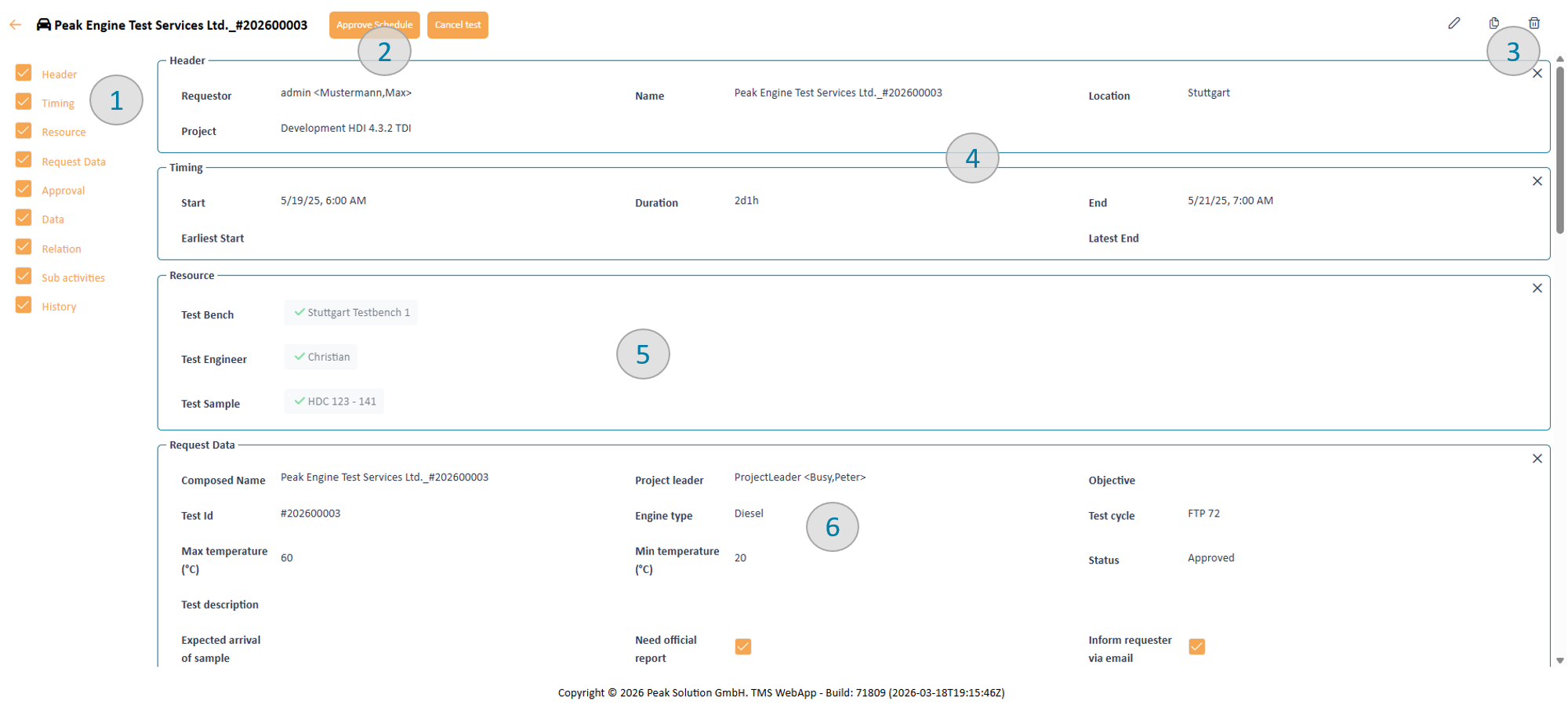
Detail page
The page design includes 4 major areas:
Navigator (pic 1)
The navigator provides an overview over different data groups of information shown in the page. Via clicking on the links of the items in the navigator the system will scroll to the corresponding data group. Disabling the checkboxes in front of the items will remove the corresponding data groups from the visible screen. This allows to focus only on data aspects you are interested in. The settings will be remembered by the system until you log out.
Worfklow (pic 2)
At the left upper corner you might find some buttons to change the state of data according to the workflow configured by your administration. In case there are no buttons you either do not have the permissions or for the current data no workflow action is possible.
Editing toolbar (pic 3)
The toolbar at the left corner provides buttons to edit / copy and delete depending on your specific rights onto the data. In case a report has been defined you find a button to download relevant reports of the data.
Header and timing (pic 4)
The header and timing provide general information which is independent of the activity type however, the fields
- project
- location
- earliest start
- latest end might be mandatory, optional or disabled by your administrator.
Resource assignments(pic 5)
Here the resources assigned to the activities are displayed, including their status of availability. Read in assign resources how to assign resources.
Grouped data panel (pic 6)
In the center you find groups of all relevant data about the displayed resource.
Relations
Similar as project management tools the application allows to maintain relations to other activities. See in manage relationships how to work with them.
(Sub) activities
As activities might be part of a hierarchy read in manage (sub) activities what they are and how to work with them.
History
If the log function is enabled for the resource type all changes since creation of the resources are listed in the history table. You can use filter functions to search for relevant changes by different system users.
Create or edit activities
Create:
You can trigger the creation of new activities from the application menu 'create' (pic 1) and from the list view (pic 2)
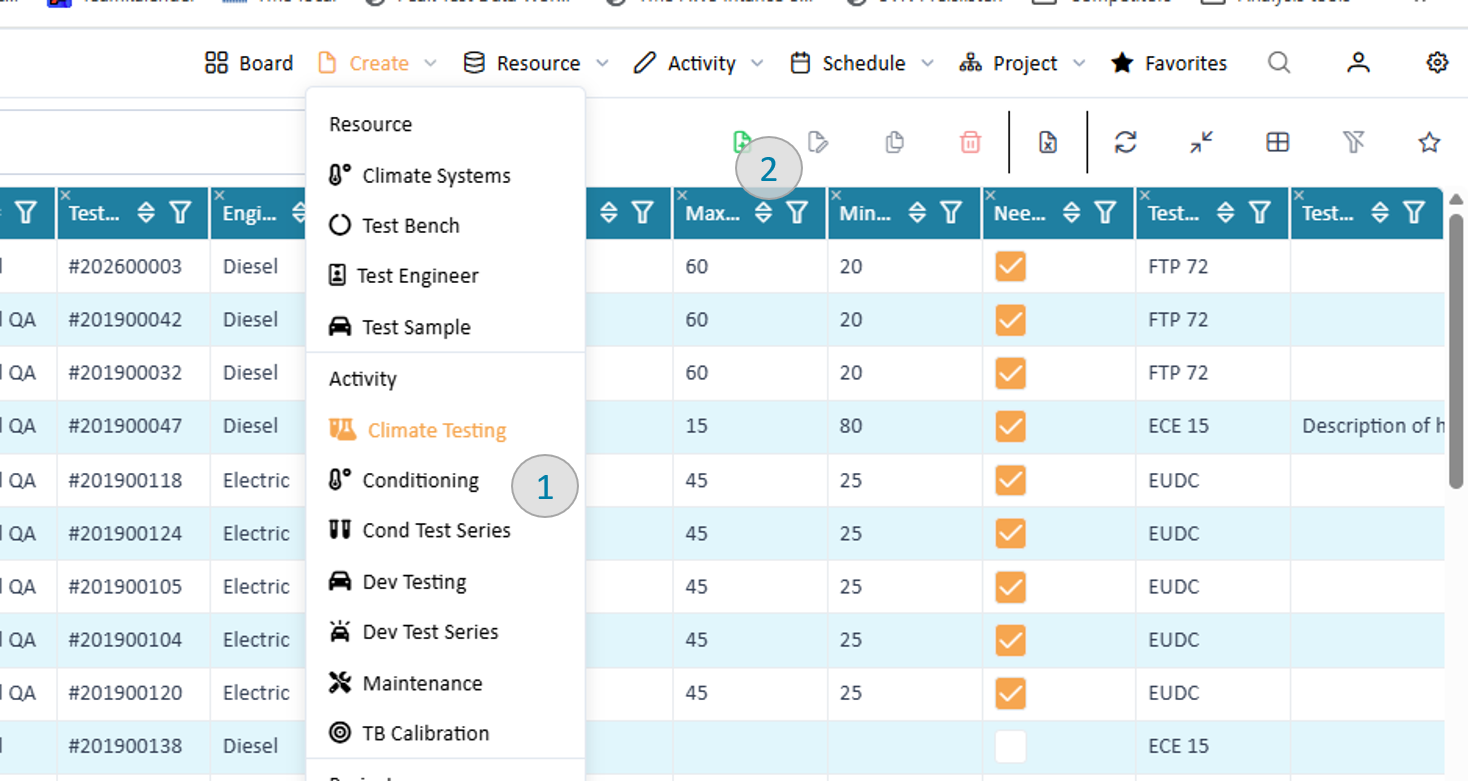
Trigger new activities
Edit:
You can start editing a resource using the edit button in the list view or detail page.
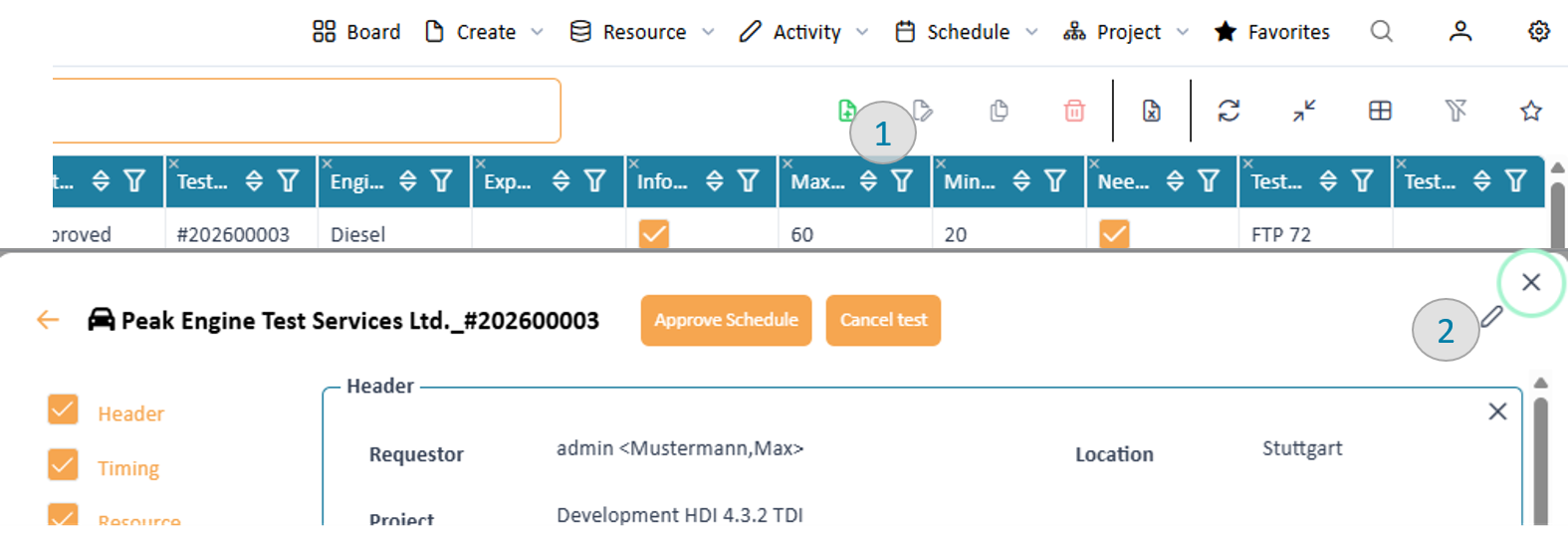
Trigger edit activity
In both cases you will enter the detail page in edit mode. The application will provide you with an assisted input form.
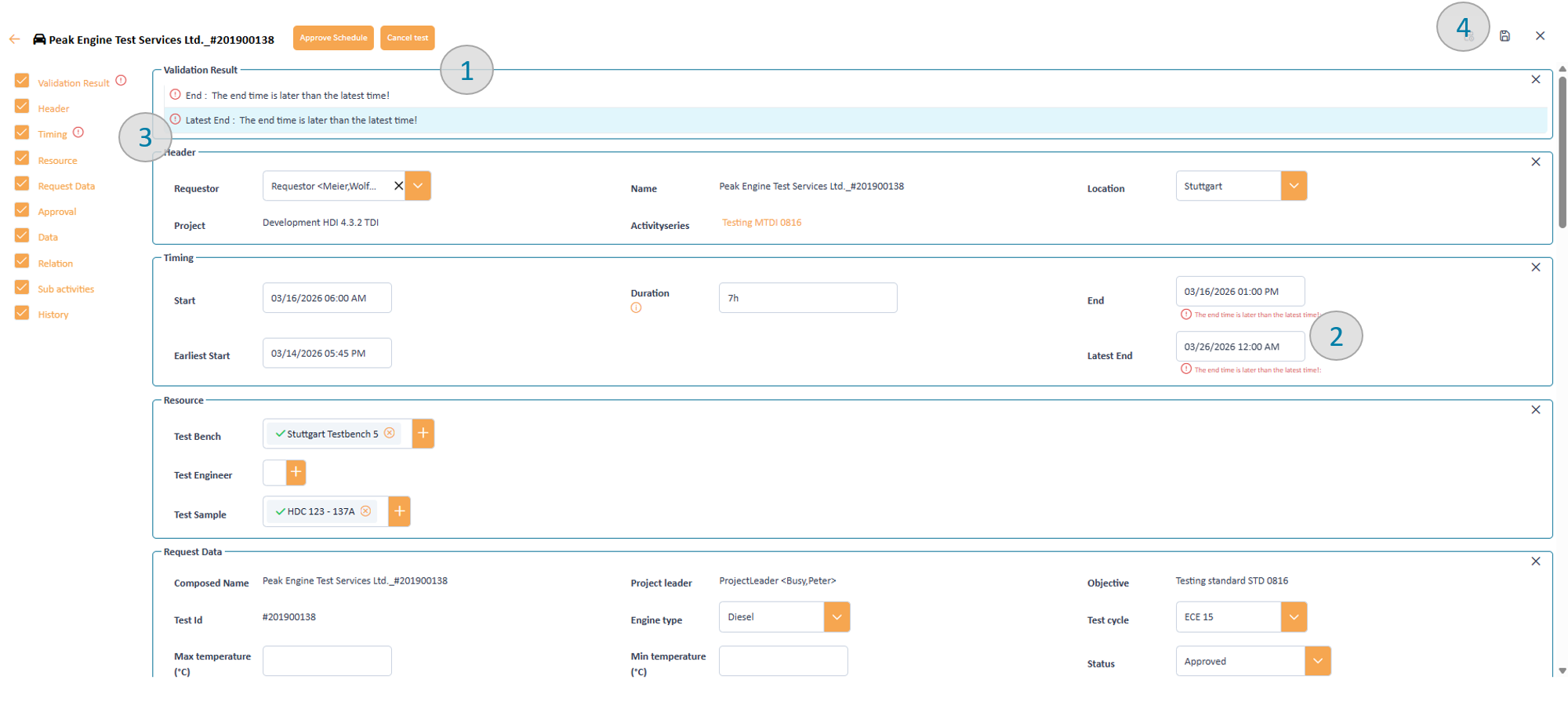
Trigger new resource
For each parameter the input form will provide an input field, if you have the rights to edit it. Whenever you edit a field a validation will be conducted. As a result of the validation the occurring warnings and errors will be displayed in the top validation area as summary (pic 1) and below each invalid field (2).
Additionally, the navigator will highlight data groups with in valid parameters (pic 3). If all errors are resolved (warnings might remain) you can save the resource (pic 4). Note that when finally saving a resource additional validations might be executed, depending on your organisation workflow.
Assign resources
Allocating resource is an important aspect of activities. Different activity types might require different resources. The resource area provides you with an overview over the assigned resources and their status of availability.

Assigned resources
You can remove resource assignments using the remove icon on the resource cards. Clicking the "+" icon will open a resource search dialog where you can search for additional resources to add:
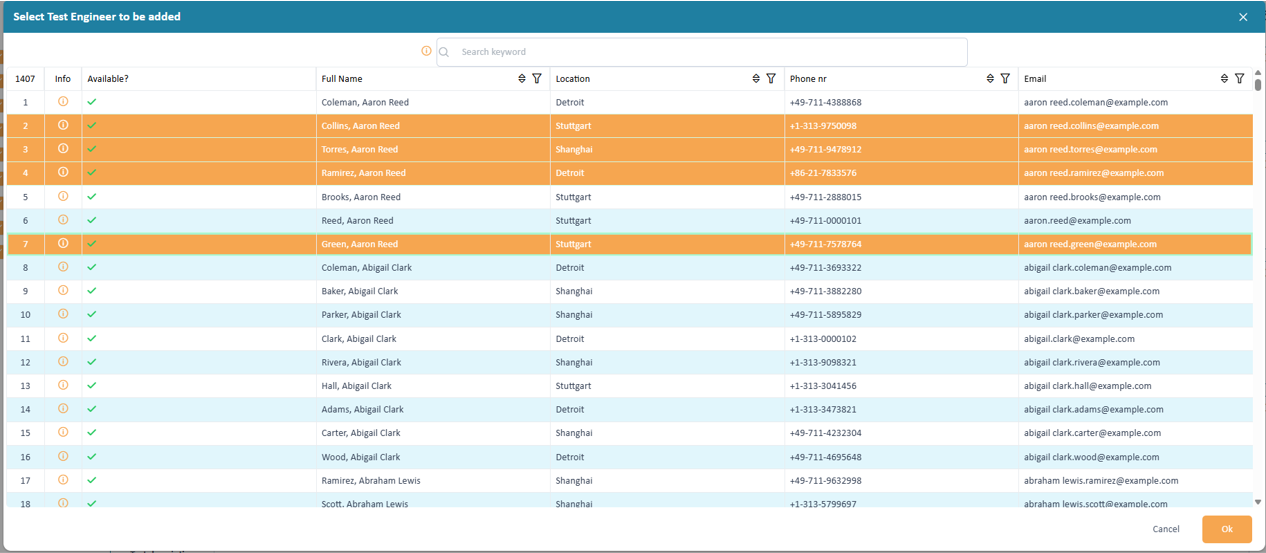
Assigned additional resources
You can use the usual filter functions to reduce the displayed data. See at filter list view how to filter list views. The first column indicates the availability of the resources in during the activity timing. Within the shown results you can mark the rows which you would like to add to the resource assignments and finally confirm with "ok".
Afterward the resources are added in the resources panel.
Manage relationships
PeakTMS allows to specify relationships between activities based on predecessors and successors with following types:
End - Begin
The end of the predecessor must be before or not later than the beginn of the successor.
Begin - Begin
The beginn of the predecessor be before or not later than the beginn of the successor.
End - End
The end of the predecessor be before or not later than the beginn of the successor.
Additionally, a fixed delay can be defined, e.g. to ensure that the next task begins exactly 3 hours after the previous on finished.
If this functionality is enabled for the specific activity type, the detail page has an area "Relation". Here all relations of an activity to others are displayed.
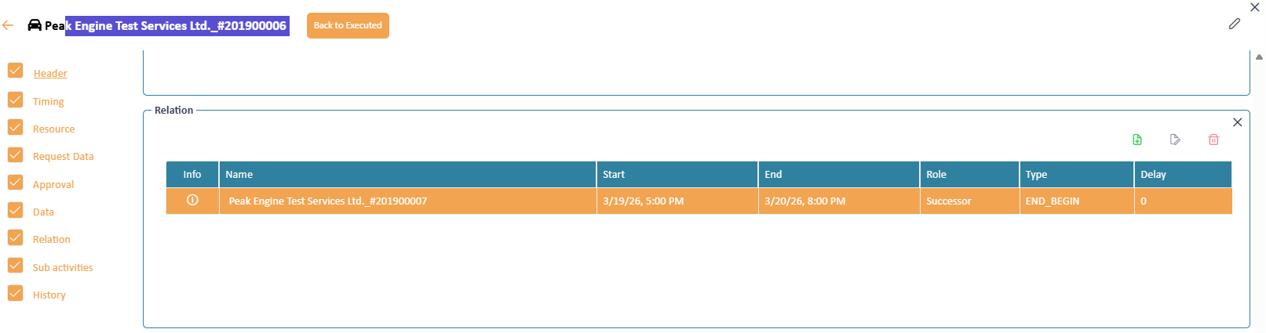
Activity relationships
The relation table gives an overwview over all relations ships of an activity including the name, start and end dates of the involved activities, including role (successor / predecessor), type and delay. Here you can create, edit or delete relationships to other activities.
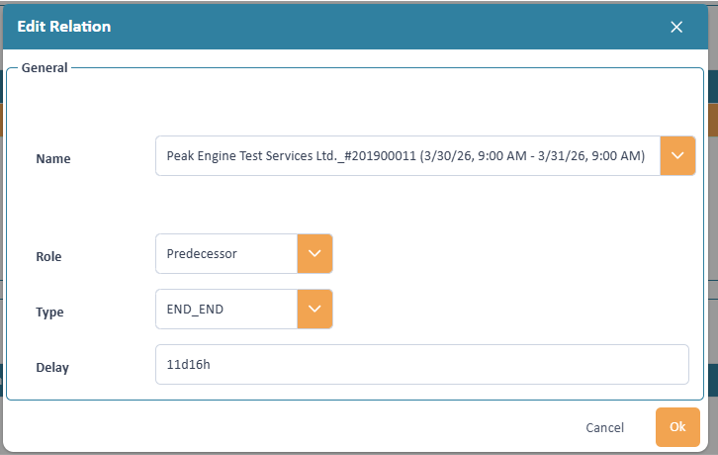
Activity relationships
Note that in the dialog for selecting activities, currently only activities within the same activity (series) are provided. However, you can create relationships via to any other activity via drag & drop in the project calendar and scheduler components.
If you don't see an area relation in your activity, the relationship functionality has been disabled by the administration.
Manage (Sub) activities
PeakTMS allows to build hierarchies based on projects and activities which can include up to 4 levels.
Project
  └── Activity (series)
    └── Activity
      └── (Sub) Activity
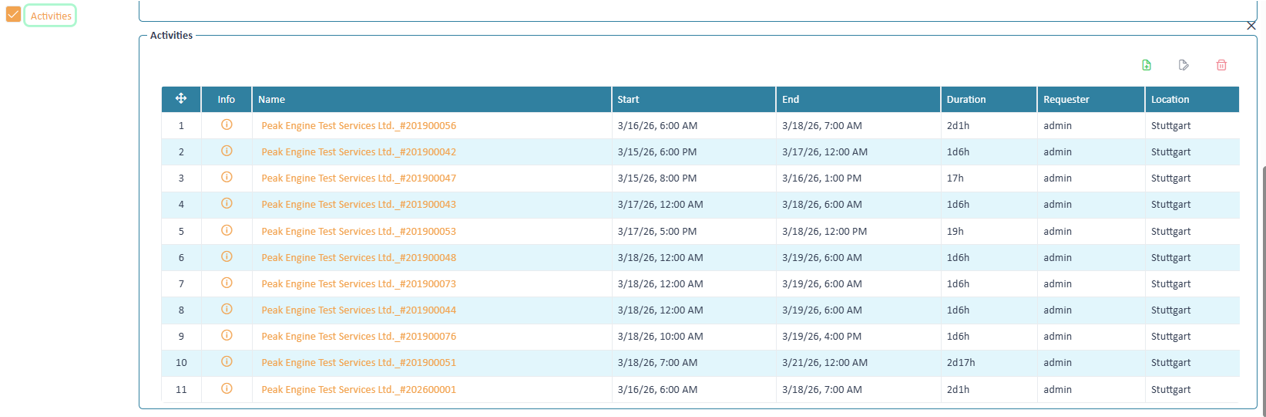
Depending whether an activity is on the 2nd or 3rd level the detail page will show an area to display and maintain the child activities.
Activity relationships
Here you can add, edit and delete the activities in the hierarchy below. If the table contains a number column (only 2nd level Activity series) you can change the positions within the table via drag & drop.
When adding a child in the hierarchy it automatically inherits the hierarchy above, e.g. the activity series and the project.
Repetitive activities
Some activities are repetitively planned in a steady interval, e.g. maintenance cycles. To make an activity a repetitive event go into the edit mode and press the repetitive event button
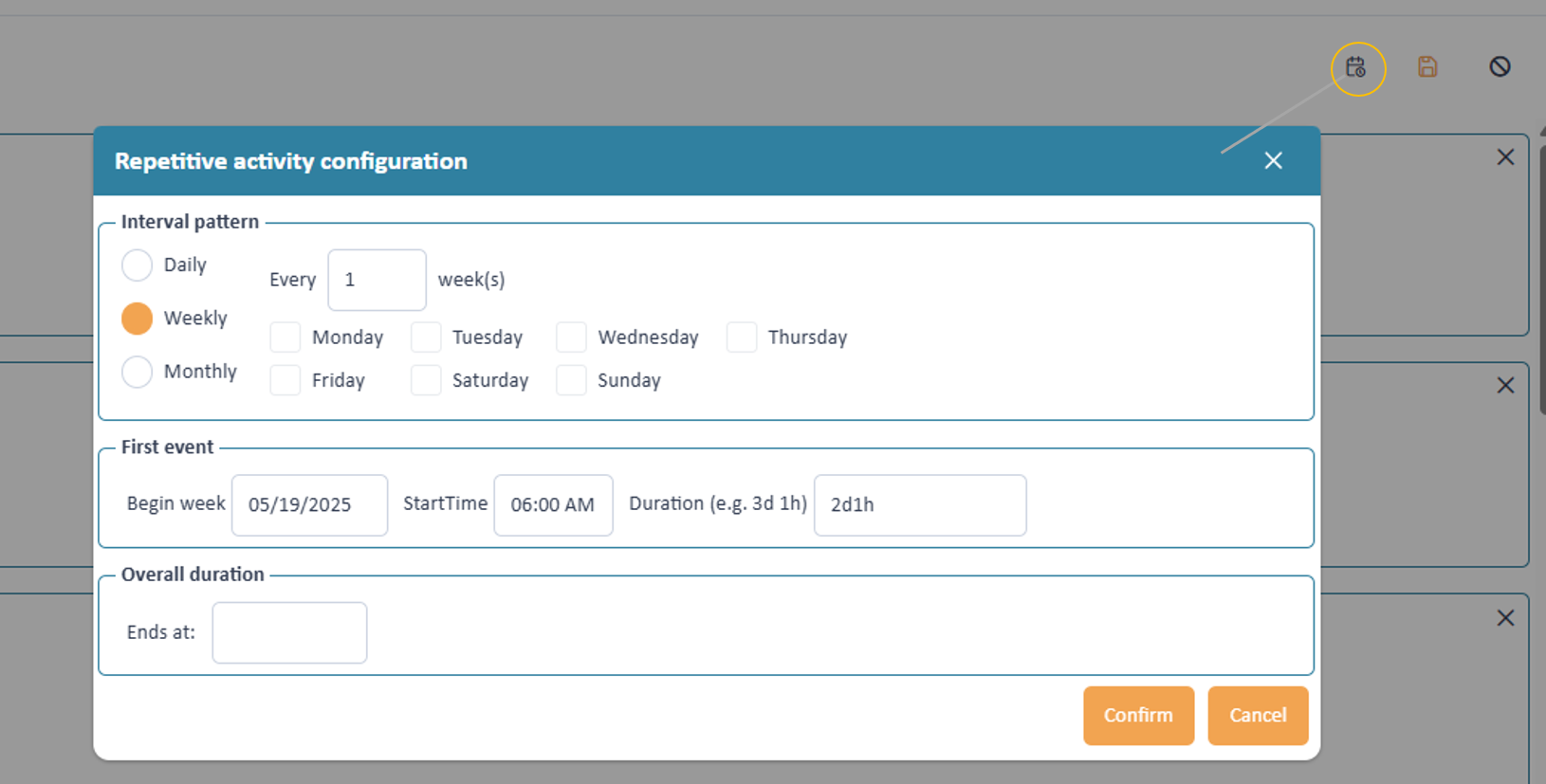
Specify repetitive event pattern
Make sure to define the event pattern, the first event (will be taken over from the former single activitiy) and the date until the event repeated and confirm
Export
Sie können die dargestellten Daten der Tabelle nach MS Excel exportieren. Dabei werden alle in der Tabelle angezeigten Spalten exportiert.
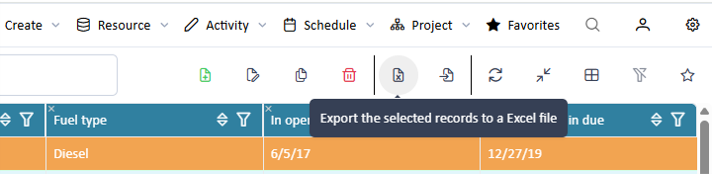
Trigger a resource export